
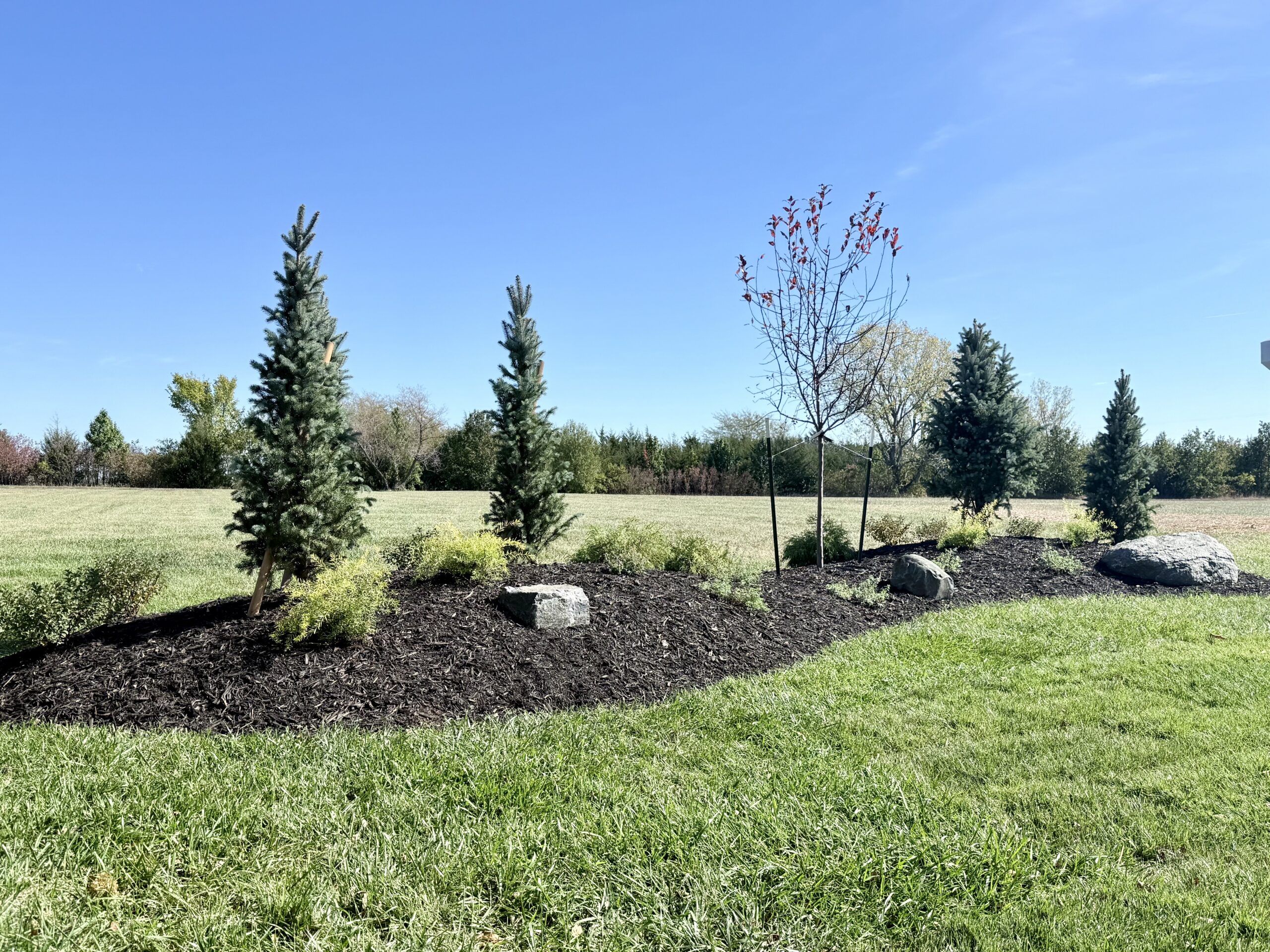
This is one of the most common questions we get, and it usually arrives with a specific version of the same story.
A homeowner is tired of buying mulch every spring. They’ve watched it fade, break down, wash out of the beds during heavy rain, and disappear into the soil by August. Somebody mentions rock, and the pitch sounds great: put it down once and never think about it again.
Sometimes that’s exactly the right call. Sometimes it’s a decision people regret three years later when they want to change a planting bed and there’s a ton of gravel sitting on top of landscape fabric.
Here’s the honest comparison, framed around what actually happens to landscape beds in Kansas.
The Short Answer
If your beds are full of shrubs, perennials, and trees you care about, mulch is usually the better choice. It feeds the soil, moderates temperature, and holds moisture during Kansas summers.
If you’re dealing with a low-plant or no-plant area, a drainage path, a foundation strip, or a space you want permanently low-maintenance, rock makes more sense.
Most properties end up wanting both, in different places. The mistake is choosing one material for the entire yard because of a single frustration.

What Kansas Weather Does to Landscape Beds
National articles about mulch and rock tend to skip the part that matters most: your climate. Northeast Kansas puts a specific set of stresses on landscape beds.
Freeze and Thaw Cycles
Our winters swing. A 60-degree afternoon followed by a hard freeze overnight is a normal February day in Topeka. That cycle causes soil to expand and contract repeatedly.
Organic mulch acts as insulation and buffers those swings, which protects perennial root systems and reduces frost heave. Bare soil under rock has less of that buffer. The rock itself holds heat during the day and gives it up quickly at night, which can actually make the temperature swing sharper right at the soil surface.
Clay Soil and Drainage
Much of our service area sits on heavy clay. Clay holds water, drains slowly, and compacts easily.
That matters for both materials, but for different reasons. Organic mulch breaks down into the soil over time and gradually improves its structure, which helps drainage in clay-heavy beds. Rock does the opposite. It adds weight and compresses the soil beneath it over time.
The bigger issue is what goes underneath the rock. Nearly every rock installation uses landscape fabric to keep stone from sinking into the soil. Fabric over clay creates a drainage problem, because water moving down through the stone hits the fabric, hits the clay below it, and has nowhere to go quickly. Beds can stay wet longer than they should.
Summer Heat
Kansas summers regularly run above 95 degrees. Rock absorbs that heat and radiates it back into the surrounding air and soil.
The temperature difference right at plant level is not small. A rock bed on the south or west side of a house can run significantly hotter than the same bed with organic mulch. For heat-tolerant plantings that’s fine. For hydrangeas, azaleas, Japanese maples, and most shade-loving perennials, it’s a slow problem that shows up as stress, scorch, and eventual decline.
Mulch does the reverse. It shades the soil, keeps root zones cooler, and reduces evaporation during exactly the stretch when plants need water most.
What Each Material Actually Does for Plants
This is the part most comparisons skip, and it’s the part that determines whether you’re happy with the decision in five years.
Organic Mulch
Mulch decomposes. That sounds like a drawback, and in terms of maintenance it is, but decomposition is also the entire benefit.
As mulch breaks down it adds organic matter to the soil, feeds beneficial microbes, improves soil structure, and gradually makes clay-heavy beds more workable. It moderates soil temperature in both directions, retains moisture, and suppresses annual weeds while it’s fresh.
The tradeoff is that it needs to be refreshed. In Kansas, most beds need a light top-off every year and a fuller replacement every two to three years, depending on the mulch type and how much sun and rain the bed takes.
Landscape Rock
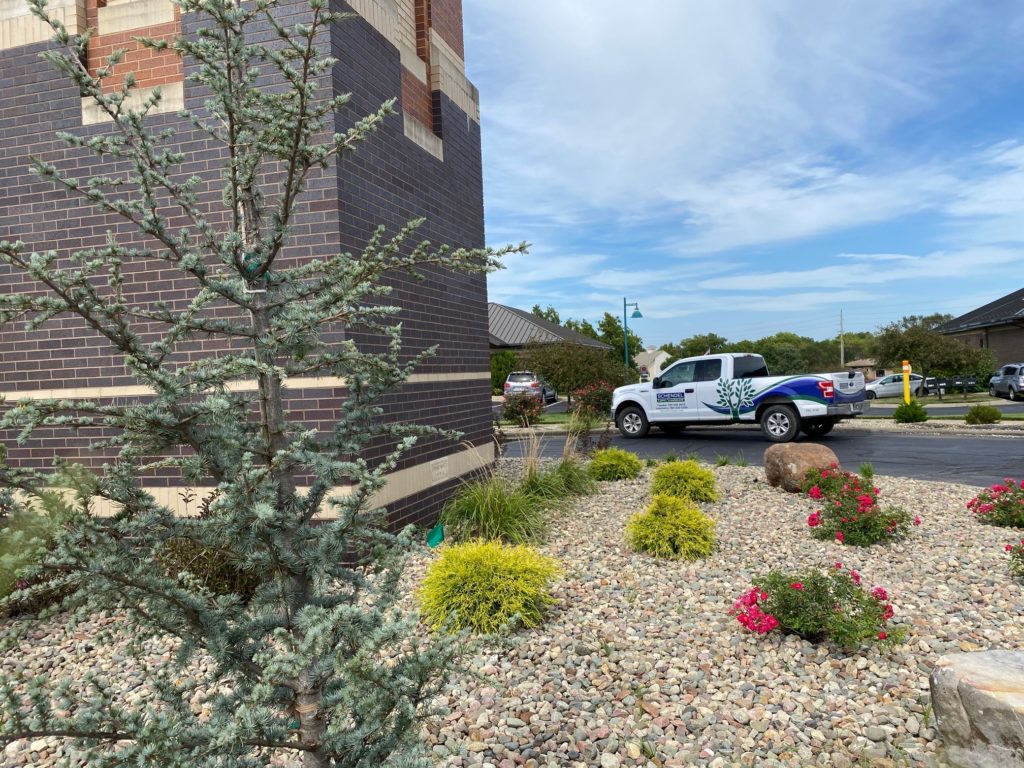
Rock doesn’t break down, which means it doesn’t feed the soil and it doesn’t need replacing. That permanence is the appeal and also the limitation.
Rock provides no nutritional benefit to plants. It doesn’t improve soil structure. Over time, soil under rock tends to compact and lose organic matter, since nothing is replenishing it. Kansas State’s horticulture guidance on mulching notes that organic mulches supply nutrients as they decompose while inorganic materials like decorative rock last longer but provide no nutrient benefit. You can compensate with fertilization, but you’re now managing something that mulch handles on its own.
Rock also isn’t maintenance-free, which surprises people. Leaves, seeds, and organic debris collect in the gaps between stones. Over a few seasons that debris breaks down into a thin layer of soil sitting on top of the rock, and weeds germinate in it. The landscape fabric underneath doesn’t help at that point, because the weeds are rooting above it.
The Five-Year Cost Comparison
Upfront pricing tells you very little here. The real question is what each option costs over time.
Rock costs more to install. It’s heavier, requires more labor to spread, and usually adds landscape fabric and edging to the scope. Nationally, installed landscape rock generally runs somewhere in the range of $90 to $240 per cubic yard depending on stone type and site conditions, while installed mulch typically falls in the $50 to $150 range. Local pricing varies with access, bed prep, and whether old material has to be removed.
Mulch costs less per installation but recurs. Rock is a larger one-time number that mostly stays put.
The crossover point in most cases lands somewhere around year three to five. After that, rock generally comes out ahead on pure material and labor cost.
Two things complicate that math, though.
First, rock beds still need periodic cleaning and eventual refreshing as debris accumulates and stone settles or scatters. It’s less work than annual mulching, but it isn’t zero.
Second, and more expensive: if you ever want to change the bed, rock has to come out. Removing several tons of stone and fabric is a real project with real labor cost. Mulch you simply plant into.
If you’re confident the bed design is permanent, rock’s long-term math is genuinely good. If there’s any chance you’ll want to redesign, add plantings, or change the layout, that flexibility has value that doesn’t show up in a cost table.
Where Each One Makes Sense
Here’s how we typically advise clients across Topeka and Lawrence.
Use Mulch For
- Planting beds with shrubs, perennials, or ornamental trees
- Beds on the south or west side of the house where heat is already a factor
- Areas with heat-sensitive plants like hydrangeas, azaleas, or Japanese maples
- Newly installed landscape beds where plants are still establishing
- Any bed you might redesign or add to in the next several years
- Around trees, where root zones benefit from cooler soil and organic matter
Use Rock For
- Drainage swales, downspout runouts, and areas that channel water
- Narrow foundation strips with few or no plants
- Beds with drought-tolerant or ornamental grass plantings
- High-wind or high-slope areas where mulch washes or blows out
- Around firepits, patios, and other hardscape features where a clean permanent edge matters
- Low-traffic areas you want to essentially stop maintaining
If You’re Converting from Mulch to Rock
If you decide rock is right for a particular area, a few things determine whether it looks good in five years or becomes a headache.
Remove the old mulch first: Layering rock over decomposing mulch creates an unstable base, and the stone settles unevenly as the material underneath breaks down.
Get the base prep right: Grade the bed properly before anything goes down. Rock is heavy and hard to adjust later.
Think carefully about fabric: It’s standard practice and it does slow initial weed growth, but over clay soil it can worsen drainage, and it stops working against weeds once debris accumulates on top. It’s worth discussing rather than defaulting to.
Match stone size to the application: Small gravel migrates and gets kicked into the lawn, where it becomes a hazard for mowers. Larger stone stays put but collects more debris in the gaps.
Get the edging right: Without a solid edge, rock ends up in your turf. That’s a recurring annoyance and a genuine safety issue during mowing.
The Honest Recommendation
Anyone who tells you one material is simply better than the other is selling something.
Rock isn’t low-maintenance so much as different-maintenance, and it’s a decision that’s expensive to reverse. Mulch is more recurring work, but it’s actively good for your plants, and it keeps your options open.
For most properties in our area, the right answer is a mix. Mulch in the planting beds where soil health and root temperature matter. Rock in the utility areas, drainage paths, and around hardscape where permanence is the point.
If you’re weighing this for your own property, we’re happy to walk the beds with you and give you a straight answer about what makes sense where. Fall is a good time to handle either project, since cooler temperatures make the work easier on both the crew and any plants being moved or added.
We serve properties across Topeka, Lawrence, and surrounding communities.
Ready to talk through your beds? Get a free estimate or give us a call.
Topeka: (785) 286-0015
Lawrence: (785) 330-5326
